ACE Leadership Hub
The conviction that
gave birth to ACE.
We believe strong communities are not built by systems alone.
We began to notice something too consistent to ignore across communities, organizations, faith spaces, and professional environments: capable people stepping into responsibilities they deeply desired, only to quietly discover they were not fully formed for what they had been given.
At the center of our work is a simple but unavoidable truth: strong communities are not built by systems alone, but by people who have been properly formed, and without that formation even the most capable individuals begin to struggle under the weight of responsibility.
This conviction was shaped over more than two decades of lived experience across leadership environments and community systems, beginning from early formation work through YoungMinds Impact Club and evolving into more structured leadership development over time.
Over time, observation became pattern, and pattern became an unavoidable question: why do systems that are excellent at identifying ability remain so inconsistent at forming the people behind that ability?
It became clear that there is a deep and persistent gap between what people are trained to do and who they are formed to be — a gap between external competence and internal grounding that no amount of skill, training, or credentials alone can bridge.
Within that gap, we saw where potential is quietly lost, where leadership begins to fail not from lack of knowledge, but from lack of formation, and where communities that should thrive remain limited by those expected to lead them.
What began as observation became conviction, and conviction became responsibility that could no longer be deferred. It is from that responsibility that ACE Leadership Hub was born — not as a programme or an idea, but as a response to a formation gap that continues to shape individuals, organizations, and communities at every level.
Our vision is simple and uncompromising: When people are formed well — grounded in character, strengthened in competence, and guided by compassion — the world around them begins to change in lasting ways, as families stabilize, workplaces strengthen, and communities begin to thrive.
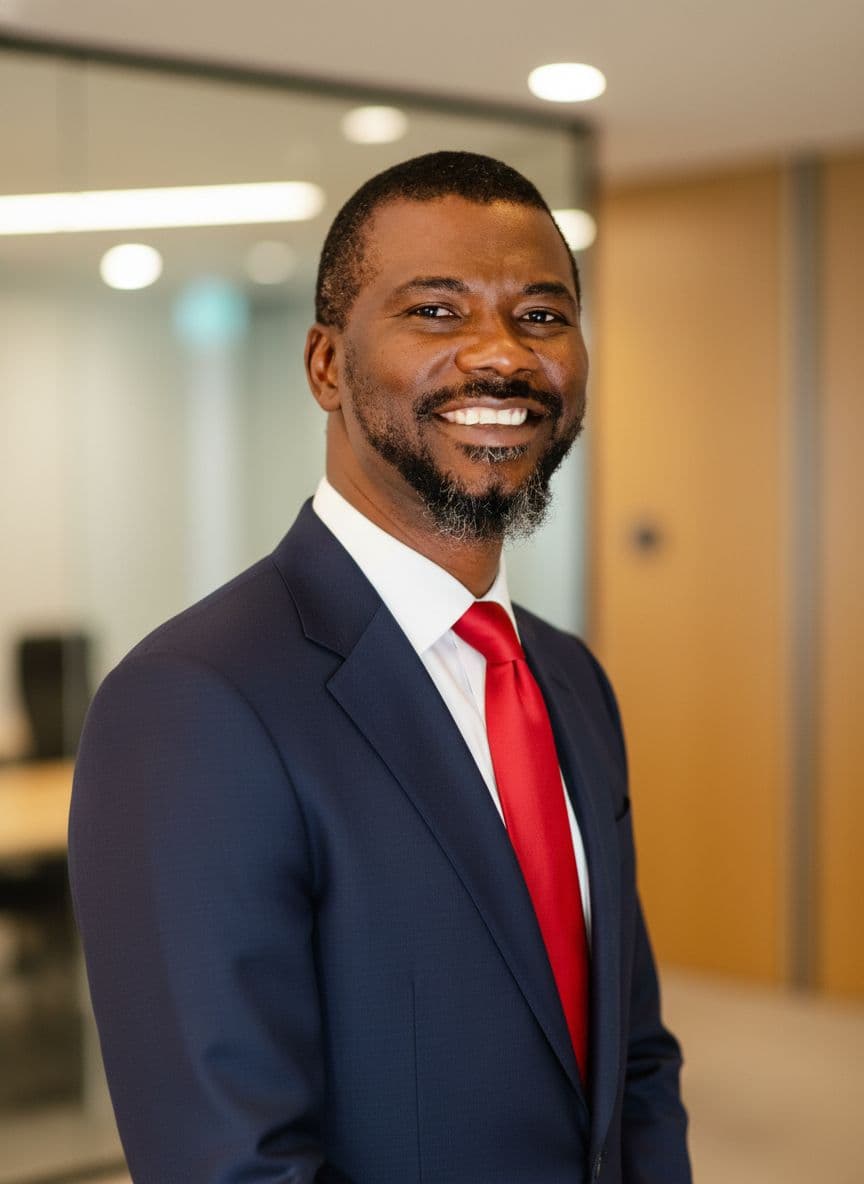
Daniel Ade-Peters
Impact
A leader who chose to build other leaders.
Dr. Daniel Ade-Peters is a faith-driven strategic leadership expert, speaker, and author with over two decades of experience helping leaders unlock potential, navigate complexity, and create meaningful impact.
Through the ACE Framework — Agency, Collaboration, and Empathy — Daniel built ACE Leadership Hub to give people a structured, intentional path to grow into the kind of leaders their families, workplaces, and communities need.
His work sits at the intersection of leadership, negotiation, and personal development, drawing on deep experience in dispute resolution and executive advisory work.
A legal practitioner and dispute resolution expert, he holds an MBA from the Paris Graduate School of Management, a Master's degree in Dispute Resolution from the University of Lagos, and a Doctorate in Leadership and Corporate Governance.
As founder of ACE Leadership Hub, Dr. Ade-Peters has trained and mentored more than a thousand emerging leaders through coaching, workshops, and structured development programs.
From Oshodi to
ACE Leadership Hub.
My journey began in the trenches of Oshodi, Lagos, Nigeria in West Africa, a densely populated and economically constrained part of the city where life was in constant motion and survival was not a theory you learned, but a reality you carried daily in how you saw people, handled pressure, and understood possibility long before you ever had language for it. I grew up in a poor home within an indigent neighbourhood, at times sharing a single room with at least five members of my family, and that reality shaped me early; it sharpened my awareness of pressure, deepened my understanding of responsibility, and made it clear that nothing in life is guaranteed unless you are willing to contend for it with intention and persistence.
In that environment, the street became its own kind of structure, culture, and informal education, where influence was visible, leadership was lived, and order emerged not from formal systems but from presence, recognition, and the unspoken rules that governed everyday survival. One expression of this was the “muwamuwa,” a local street group whose very name carried the idea of “bring it,” and which shaped how respect, protection, and direction were negotiated without any formal authority behind it. Within that world was a young man known across Oshodi as Big Bomboy, now of blessed memory, who, in the eyes of many of us growing up there, embodied presence, authority, and a natural command of influence that made leadership feel tangible rather than theoretical — something you could see, feel, and respond to in real time.
So when I say I wanted to become the head of the muwamuwa, it was not fantasy detached from reality, but my earliest expression of a leadership dream shaped by the world I knew. It represented visibility, respect, and the ability to shape direction in a place where direction was rarely given and often had to be claimed, and looking back, that desire was not random ambition but the early unfolding of something already forming within me long before I had language for it — a pull toward leadership that was instinctive, observational, and deeply embedded in how I began to interpret people and systems.
To step into that world more deliberately, I began boxing training to prepare myself physically and mentally for what I believed leadership required in that context, while still navigating school and the realities of a neighbourhood where structure was thin and every day demanded awareness, adaptability, and positioning, until life interrupted that trajectory through a recurring health challenge that forced me out of training in a way I did not plan and could not control, creating an unexpected pause that removed me from what I thought I was building and opened space for reflection I had never slowed down enough to access.
It was in that season of interruption that I was invited to an evangelical meeting where, after the message, I made a personal decision to give my life to Christ as it was presented, and although I could not fully explain it at the time, that moment marked a quiet but irreversible shift in how I understood life and leadership, because leadership stopped being about control or recognition and began to take shape as responsibility, service, and the internal process of becoming the kind of person capable of carrying influence without being consumed by it.
From there, life led me into law, where I became a legal practitioner, and later into mediation and dispute resolution as an accredited mediator, placing me directly in the middle of real human conflict where decisions were never abstract and outcomes carried weight in people's lives, relationships, and futures, and in those spaces I began to see human behaviour under pressure in ways that sharpened my understanding of systems, choice, consequence, and leadership in practice rather than theory.
I went on to further academic and professional formation, earning a Master's degree in Dispute Resolution from the University of Lagos, an MBA from the Paris Graduate School of Management, and a Doctorate in Leadership and Corporate Governance, each stage adding structure and language to what I had already begun to observe about how systems function, how people respond under pressure, and how leadership actually unfolds in complex environments.
Alongside this, I stepped into pastoral leadership as a pastor and teacher of the Word, entering a deeper dimension of responsibility where leadership was no longer only about systems and decisions, but about identity, meaning, faith, and the inner life of people, which further deepened my conviction that what shapes outcomes most is not only what people can do, but who they are becoming.
Across law, mediation, governance, and pastoral work, one pattern kept revealing itself with increasing clarity: capable, intelligent, and well-positioned people were still struggling to sustain leadership, relationships, and responsibility over time, and the more this repeated itself, the more unavoidable it became that the issue was rarely ability, but almost always formation, because people were stepping into roles they had not been internally prepared to carry.
Eventually, that observation stopped being something I merely noticed and became something I could no longer ignore, and what I could no longer ignore became conviction, and what became conviction eventually became responsibility — and it is from that responsibility that ACE Leadership Hub was born.